Updates:
Press Conference Announcement (November 23, 2009)
Airlift Support Enters Third Week (November 18, 2009)
How to Help (November 18, 2009)
Mr. Feng Zhenghu, is a Chinese citizen, a resident of Shanghai, with a valid passport of the People’s Republic of China (G33406155). He is a human rights lawyer and a signer of Charter 08, a document calling for political reform in China published on the Internet on December 10, 2008, the 60th Anniversary of the United Nations Universal Declaration of Human Rights to which the PRC is a signatory.
Mr. Feng, 55, is a graduate of the Huadong Normal University, Department of Mathematics. In 1986, he received his Master’s Degree in Economics from the Fudan University, School of Business. He worked as the director of Research Student’s Union, Federation of the Shanghai Student’s Union, and director of the Shanghai Research Student’s Science and Economics Center. He also worked as lecturer at the Shanghai University of Finance after his graduation. At the same time, he worked as the director of the Shanghai Business Development Association, and dean of the China Business Development Research Institute. He sponsored the annual “China Business Development Forum” for four consecutive years, and is the author of “Business Strategy”, “Chronology of China Business Development.”
In April 1991, Feng Zhenghu went to Japan to study and became a resident there. In 1998, he went back to China and in September of that year started a company named “Tianlun Consulting.”
In 2000, Feng Zhenghu was arrested because of a book he published, “Japanese Companies in Shanghai”. He was sentenced to three years in prison.
Feng became a rights activist after he got out of prison. He opened a website for safeguarding the Constitution and defending human rights. He started publishing “Brief on Oversight” in July 2007. In 2007, Feng started publishing “Witness to judicial injustices in Shanghai”.
On October 7th, 2009, Mr. Feng arrived in Washington, DC as a delegate from Mainland China, to the Fifth Interethnic/Interfaith Leadership Conference, At this conference, hosted by Initiatives for China and funded by the National Endowment for Democracy, he joined other delegates from religious, ethnic, and regional backgrounds that comprise contemporary China. The purpose of the conference was to explore common ground and advance respect and understanding between these groups, who are often divided by mistrust and misunderstanding. The conference concluded with a joint statement of commitment to non violent action and cooperation in the pursuit of their common goal of justice and the rule of law in China. The statement also called on international support for actions by the Chinese goverenment that would begin the process ofrestoring the rule of law to China. Among these actions was to enforce the right of return of Chinese citizens to their homeland.
Between June 7, 2009 and November 3, 2009, Mr Feng made eight unsuccessful attempts to enter his homeland of China. Each time he was denied entry. Article 13 section 2 of the United Nations Universal Declaration of Human Rights reads “ Everyone has the right to leave any country, including his own, and to return to his country.”
On the night of November 3rd 2009, Mr. Feng boarded NH921 Fight of All Nippon Airlines and arrived at the Shanghai Pudong Airport at 21:10 (China Time). He was refused entry for the eighth time. After a period of prolonged and heated argument with the Chinese authorities, Mr. Feng was forcibly placed on a plane back to Japan from where he had departed.
After his forced returned to Tokyo, Feng gave up a Japanese visa, saying that he did not want to enter Japan, but rather wanted to exercise his legal right to return to his own country and family. He has been surviving with little food, no bathing facilities, and sleeping on seats in the Terminal One arrival area of Narita International Airport.
Mr. Feng’s situation reflects the plight of hundreds of “blacklisted” citizens who are barred from entering their homeland, even though they have valid passports and have every right, under Chinese and International law, to return home. This practice of blacklisting serves no purpose but to silence the voices of citizens raised to improve their system of government. A partial list of blacklisted citizens is attached.
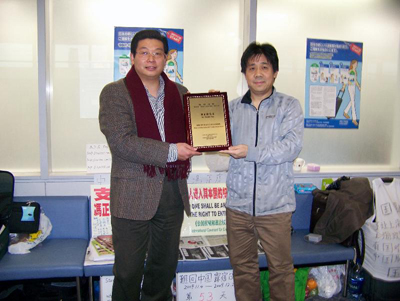
As of this date, Mr. Feng remains in Terminal One at Narita Airport. He is surviving on provisions and ammenities “airlifted” by supporters under the auspice of Initiatives for China, who is coordinating logistical and communication support. International wareness and support is mushrooming around the world. Supports are communicating with Mr. Feng via Twitter. Supporters in Stockholm Sweden have been handing out flyers to people departing for Japan, Articles have appeared in numerous publications including the Financial Times and the Los Angeles Times. Information obtained by Initiatives for China also indicates that the situation of Mr. Feng has reached the highest levels of Chinese government.
The following contact information for Mr. Feng is provided:
Cell Phone: 0081-80-3345-7210 13524687100, 13331888531
Email: fzh2005(at)hotmail.co.jp
Partial List Chinese Citizens Blacklisted by the Chinese Government
Yang Jianli, Wang Juntao, Wuer Kaixi, Hu Ping, Guo Luoji, Chen Yizi, Zhang Weiguo, Liu Gang, Chen Xiaoping, Wu Renhua, Liu Nianchun, Fu Shenqi, Yi Gai, Wei Quanbao, Cai Guihua, Bei Dao, Wang Ruowang (deceased: Dec 19, 2001), Liu Bingyan (deceased: Dec 4, 2005)
June 16, 2009
130 Chinese citizens in China signed a petition letter named “Support Feng Zhenghu’s return to China” (http://www.64tianwang.com/bencandy.php?fid=12&aid=4732) and as of August 15, 1540 people signed the petition to support.
An email was started to collect signatures to support rights to go back to China:
huiguohuijia@gmail.com
Aug 15, 2009
A number of Chinese businessmen in Japan released “Legal Argument on Defending Chinese Citizens Rights to Go Back to China”
Aug 25:
On the morning, Feng Zhenghu and his Japanese lawyers filed a lawsuit against Air China to the Tokyo District Court. His lawsuit was accepted. Case Number: 29911. The reason for the lawsuit: Air China violates the human rights of Chinese citizen in refusing to carry a Chinese citizen to China on June 17.
Sept 1, 2009
“Exiling Chinese Citizens Rights to Go Back to China” seminar was held in New York, USA. It was sponsored by “Beijing Spring” journal and “Initiatives for China”.
Oct 29:
Mo Shaoping, a lawyer in China, was retained by Feng Zhenghu in filing a lawsuit against the illegal actions of the Shanghai Border Control Police.
Nov 2:
The court in Tokyo started proceedings at 10:00am in Feng Zhenghu’s suit against Air China in violating his rights to China. The court room was 615. The scheduled court hearing for Oct 5, 2009 was adjourned at the request of the Defendant’s Counsel on reasons that they needed more time to prepare the case.
June 7:
Chronology Mr. Feng Zhenghu’s Denial of Entry To His Homeland
Refused entry to China. On the afternoon, at 3:05pm, Feng Zhenghu arrived at the Pudong Airport in Shanghai on board Air China Flight Ca930. He was not allowed to enter by the Shanghai Border Control Police. The police gave him a boarding pass of the All Nippon Flight NH0154 and forced him to board the plane. At 9:25pm, he arrived at the airport in Osaka, Japan.
June 17:
Blocked from boarding aircraft in Japan. On the morning of that day, Feng Zhenghu boarded Air China Flight CA158 to go back to China. At 8:10am, he passed through customs with a boarding pass. His seat number was 12L. His passport was received an exit stamp from the Japanese government. At He was blocked from entering the aircraft by Sun Xiaorong, representative of Air China at the Narita Airport. The reason: the Shanghai authorities asked them to stop Feng Zhenghu from boarding the plane.
June 24:
Denied entry to China. At 1700 hours, Feng arrived at the Narita Airport, and boarded the Northwest Airlines (US), Flight NW27, to go back to China. The plane arrived at the Pudong Airport of Shanghai at 21:15pm. The border control police at the airport told him that according to superior orders, Feng was not allowed to enter China. On that night, he was escorted to a local hotel to spend the night. The next morning, he was directly sent to the Northwest Airlines plane NW28, and was forcibly sent back to Japan.
July 2:
Denied boarding China bound flight from Japan. At 17:00 hours, Feng arrived at the Narita Airport, Tokyo, and was prepared to board the NW27 flight of the Northwest Airlines to go back to China. While waiting for the boarding pass, the representative of the Northwest Airlines asked Feng to buy a return ticket before he could get his boarding pass. Feng refused, and was not permitted to board the plane.
July 9:
Denied boarding. At 17:00, Feng Zhenghu arrived at the Narita Airport, and was prepared to board the 19:05pm Flight NW27 to go back to China. After he got round trip tickets, he was still refused boarding the plane by the Northwest Airlines. The reason was the Shanghai authorities refused Feng from entering China.
July 16:
Denied boarding on flight to China. At 17:00, Feng arrived at the Narita Airport, and was prepared to board the NW27 Flight of the Northwest Airlines to go back to China. Feng held a valid Chinese passport, and plane tickets, but he was still refused boarding the plane by the Northwest Airlines.
July 31:
Denied entry entry. On the afternoon, at 4:00pm, Feng arrived at the Narita Airport, and boarded NH0921 Flight of the All Nippon Airlines to go back to China. At about 8:30pm, he arrived at the Pudong Airport of Shanghai. He was escorted to a local hotel for the night, and the next morning he was sent directly to the NH0922 Flight of the All Nippon and was sent back to Japan.
Nov 3:
The eighth time Feng was refused entry. On the night, Feng boarded NH921 Fight of All Nippon Airlines and arrived at the Shanghai Pudong Airport at 21:10pm (China Time). Mr. Feng was forcibly placed on a flight to Japan. He remains at Terminal One, Narita Airport as of this date.